Pouvreau Vaton 60 (1984) — Mastered Offshore Architecture
Some sailing yachts merely cross oceans.
Others embody a naval philosophy.
The Pouvreau Vaton 60, designed by Gilles Vaton and built in aluminium by the Pouvreau yard in 1984, belongs to the latter category. It does not seek spectacular aesthetics or demonstrative luxury: it follows a rigorous architectural logic, entirely oriented toward bluewater sailing.
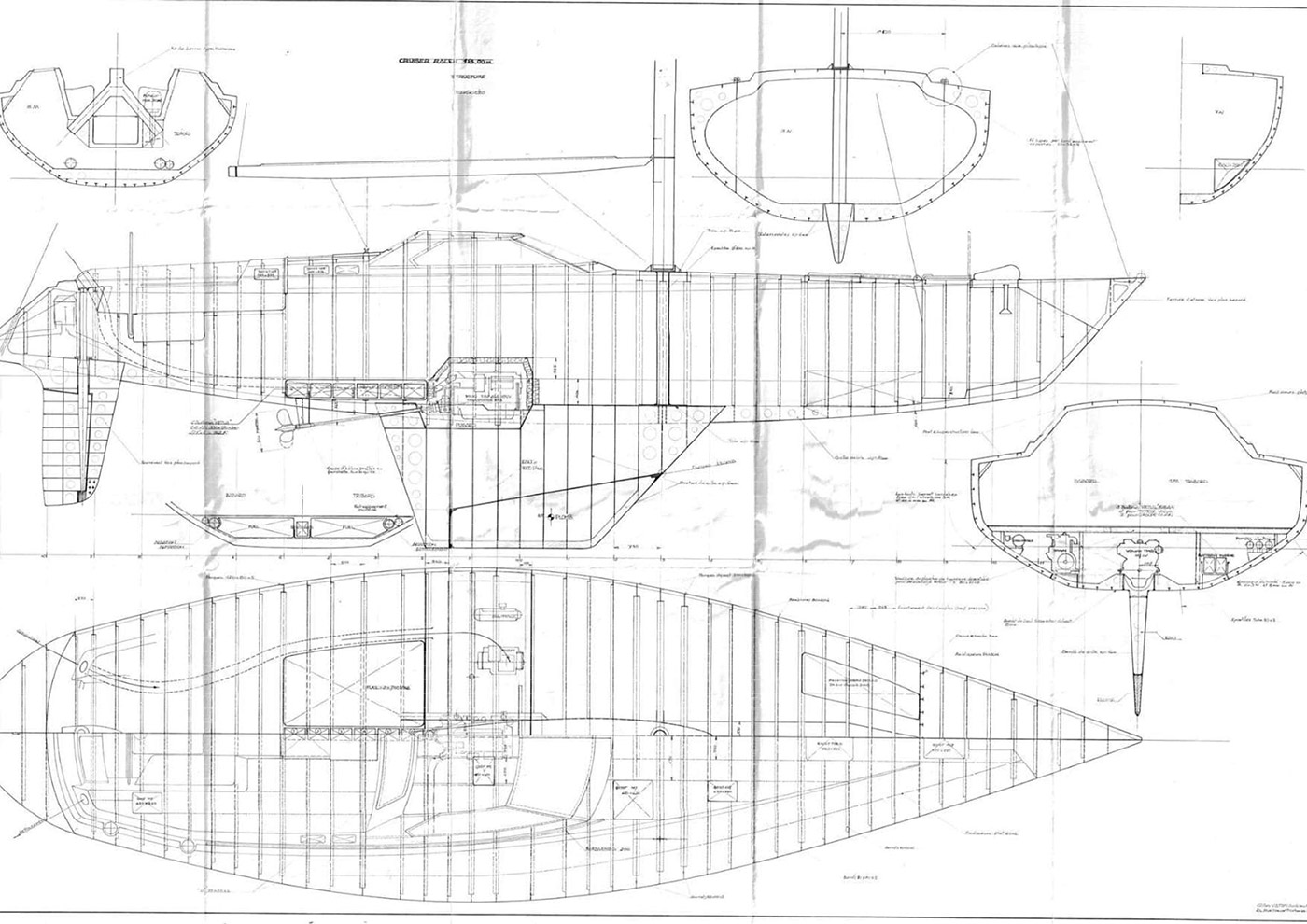
The technical sketches immediately confirm the maturity of the design. Nothing is superfluous. Everything is structure.
I. Architectural Reading — A Hull of Authority
The analysis of the sections and longitudinal profile reveals a powerful displacement hull with softened chines.
1. Bow: Controlled Entry and Inertia
The stem shows a fine entry, slightly raked, with moderate rake.
The waterline develops without interruption toward a forward volume that remains substantial yet never overloaded.
This geometry responds to three imperatives:
-
reducing impact in heavy seas,
-
maintaining consistent longitudinal inertia,
-
progressive lift in the wave.
The sheerline is measured, free of decorative intent. It supports the deck line within a continuous structural logic.
2. Aft‑Shifted Beam: A Vaton Signature
The sections show a beam positioned slightly aft of the geometric centre.
This deliberate choice, typical of Vaton, increases aft form stability, enhances lift under sail, and improves directional control.
The stern retains substantial volume, ensuring stable trim both downwind and under power.
This is a yacht designed to maintain an average speed, not to chase peaks.
3. Deep Keel: Tracking and Rigidity
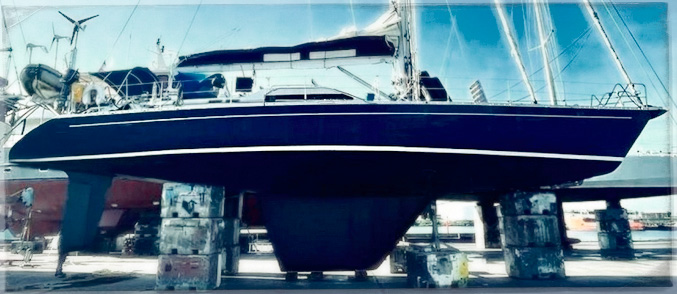
The keel, a deep fin keel (2.70 m), features:
-
a generous lateral plane,
-
a thick hydrodynamic profile with high inertia,
-
a structurally massive attachment.
The keel‑to‑hull junction, visible in the structural plans, relies on reinforced floors and a tight continuity of frames.
In aluminium, this zone is decisive: here, it reflects a design intended to absorb repeated offshore loads.
The rudder, independent yet dimensioned with authority, integrates into a coherent aft plan, ensuring firm steering without overcorrection.
II. Aluminium Structure — Continuity of Loads
The longitudinal plans reveal an exemplary internal architecture.
One observes:
-
a regular grid of closely spaced frames,
-
massive floors at the keel interface,
-
longitudinal stringers ensuring flexural rigidity,
-
structural bulkheads integrated into functional zones.
This structure does not seek extreme lightness. It prioritises:
-
torsional resistance,
-
long‑term durability,
-
repairability in remote areas,
-
impact absorption capacity.
In summary: welded aluminium, continuity of loads, mechanical simplicity, durability.
The plan clearly expresses the load paths:
the mast is stepped on a structurally reinforced zone, with direct load transfer to the keel via floors and bulkheads.
Centre of effort and centre of buoyancy interact with precision.
III. Sail Plan — Rational Power
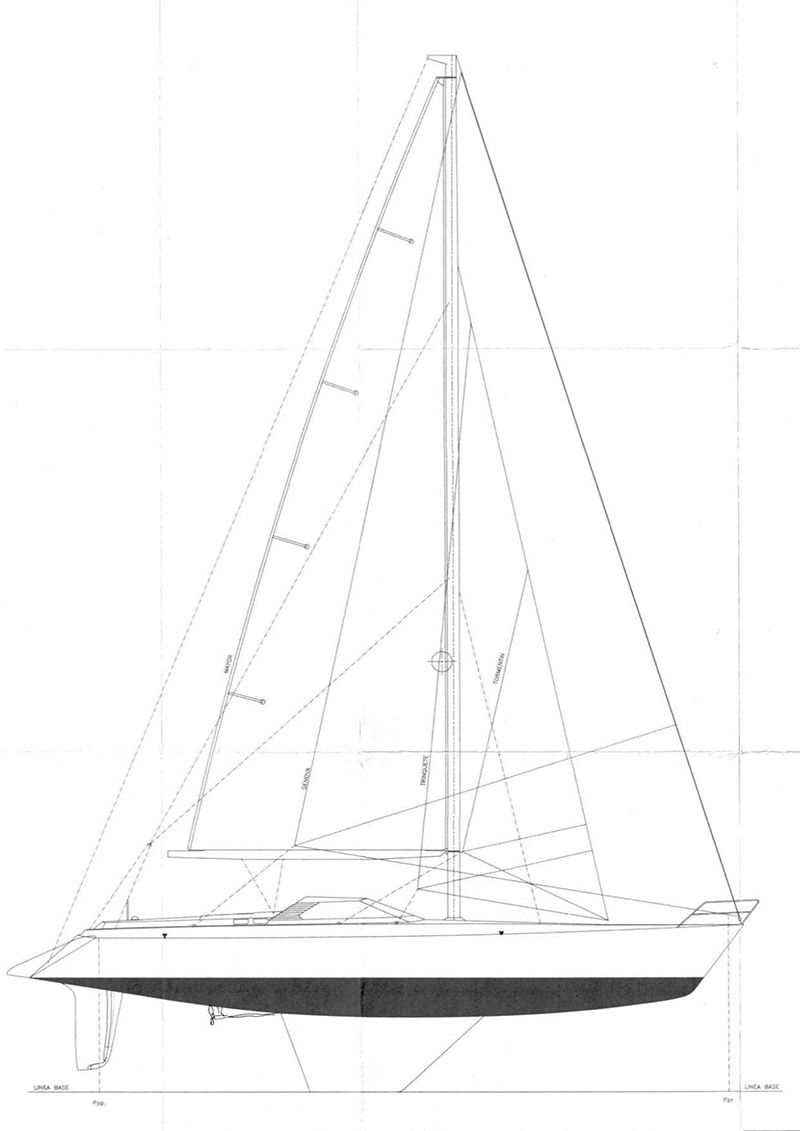
The sloop rig is clear, balanced, and dimensioned for offshore work.
The proportions confirm:
-
a generous foretriangle,
-
a high‑aspect mainsail,
-
a surface distribution favouring versatility.
This type of rig does not seek excessive sail area. It aims for:
-
speed stability,
-
ease of reefing,
-
management by a reduced crew.
The geometry of the rig expresses a desire for sustained performance rather than instantaneous speed.
This is a yacht that maintains its pace over time, without structural fatigue.
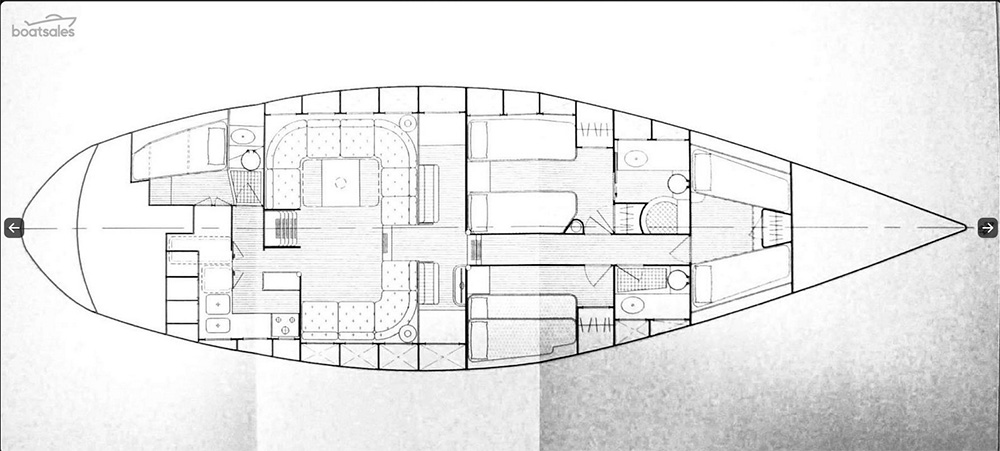
IV. Interior Plan — Oceanic Ergonomics
The interior layout confirms a distribution conceived for the sea, not the marina.
1. Saloon at the Beam
The saloon is positioned at the yacht’s dynamic centre — the most stable zone underway.
A fundamental choice for bluewater cruising.
2. Secure Longitudinal Galley
The galley, aligned longitudinally, allows efficient bracing when heeled.
Volumes are generous yet controlled.
3. Cabins Structured Around Bulkheads
The cabins are arranged in coherence with the load‑bearing bulkheads.
Internal circulation remains fluid despite the overall volume.
Four cabins and three heads over 18 metres reflect a long‑range expedition programme without ostentation.
The headroom (1.85 m) and natural ventilation contribute to functional, not decorative, comfort.
The examination of the sketches confirms a constant in Gilles Vaton’s work:
-
architectural clarity,
-
longitudinal balance,
-
hydrodynamic coherence,
-
a refusal of gratuitous aesthetic concession.
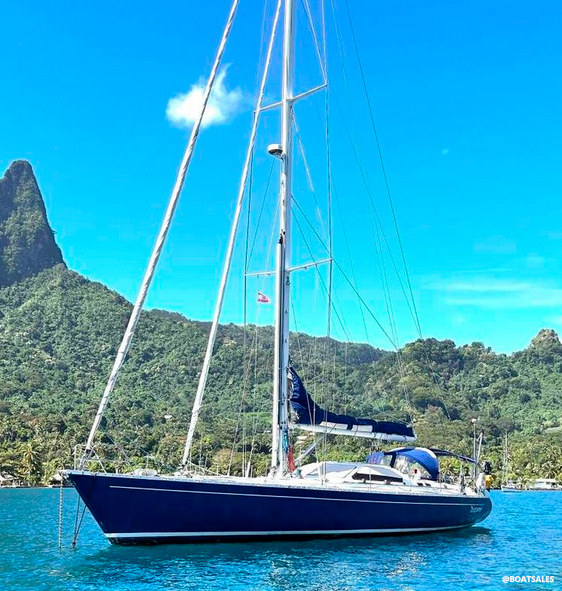
The Pouvreau Vaton 60 does not seek to impress at the dock. It asserts itself through the logic of its lines.
Its 26‑ton displacement, 5.50‑metre beam, deep keel, technical autonomy (1,000 L of diesel, 1,400 L of water) and rational rig combine to form a complete expedition platform.
This type of vessel is an instrument of true bluewater navigation.
Specifications
Dimensions & Hull Architecture
-
Length overall (LOA): 18.00 m
-
Maximum beam: 5.50 m
-
Draft: 2.70 m (deep fixed keel)
-
Light displacement: 26,000 kg
-
Type: Aluminium displacement monohull
-
Keel: Deep fin keel with substantial lateral plane
-
Rudder: Single, independent, dimensioned for heavy displacement
-
Beam slightly aft‑shifted (Vaton signature)
-
Hull with high longitudinal inertia, buoyant aft sections
-
Structure: Welded aluminium, closely spaced frames, massive floors
-
Deck: Structurally integrated aluminium deck
Sail Plan & Aerodynamic Balance
-
Rig: Sloop
-
Full‑batten mainsail: 74 m²
-
Genoa: 114 m²
-
Staysail: 35 m²
-
Upwind sail area (main + genoa): 188 m²
-
Staysail + main (heavy‑weather configuration): 109 m²
-
Downwind sails: 3 (never used)
-
Standing rigging partially renewed in 2022
-
Sail area distribution favouring speed stability and progressive reefing
Interior Structure & Programme
-
Layout: 4 cabins
-
1 queen cabin
-
2 double cabins
-
1 single cabin
-
-
Berths: 8 + convertible saloon
-
3 heads
-
Headroom: 1.85 m
-
Saloon positioned at the beam (maximum stability zone)
-
Longitudinal galley secured for offshore use
Synthetic Architectural Reading
-
Beam‑to‑length ratio: 0.30 → significant form stability
-
Heavy displacement → favourable offshore inertia
-
Draft 2.70 m → efficient upwind tracking
-
Sail area 188 m² → power matched to displacement
-
Aluminium structure → rigidity, repairability, longevity
This Vaton 60 is an 18‑metre ocean platform designed to hold the sea for long periods, under load, with structural authority.